
5 Under 5 Interview with Charlotte Steel
Meet the artist behind Tailor-made, exhibiting on The Wall in the concourse.
How would you describe your creative process from concept to completion?
A: My creative process usually stems from an idea or an image I picture in my head that builds up as I go. I start constructing the original picture in my head, and along the way ill add to it with ideas and concepts that pop into my head. Sometimes I do a little experimenting to see what works, but more often than not I’ll get right into it and learn as I go. As my work develops, the initial image shifts in my head with the addition of concepts and ideas; sometimes, the image in my head completely changes throughout the process. However, if that doesn’t happen and the image stays the same, but my work doesn’t match it (which is often because it’s rare that the image and the final product look the same), I can get a bit fed up and leave it, resuming in a few days with fresh eyes. I don’t really know when it’s “done”, I simply just continue until I’m happy with the outcome and can’t think of anything to add or don’t want to change it.
Where do you find inspiration, and how do you handle creative blocks?
A: I usually take inspiration from other work I see on social media or from what I’m doing. I’ve always liked Bill Hammond’s work, especially “The Fall of Icarus”. The colours and techniques he uses, especially the materialism he uses, have always piqued my interest. I’ve also recently been inspired by Sophie Tea. I really like her work, and the colours she uses are always really pretty and cohesive. With art, I’m definitely more of an aesthetic viewer in the sense that I like a painting that looks pretty, even more when it has an interesting story, but the aesthetics are always at the forefront when I myself am creating. Occasionally, stories or concepts I like form images in my head that do inspire me, such as the 1986 film Labyrinth with David Bowie, for example. I recently read a book that takes inspiration from the story that I absolutely love, and whilst reading, I imagined some various pieces of art I could create with them as my inspiration. In terms of my pieces for the exhibition, Lydia Broderick and Jesus Leguizmo were a big part of my inspiration around some of the techniques they used in various pieces.
I often have creative blocks and honestly, just scrolling through Pinterest can give me a good starting point for a new project.
What have you learnt about yourself through working on this exhibition?
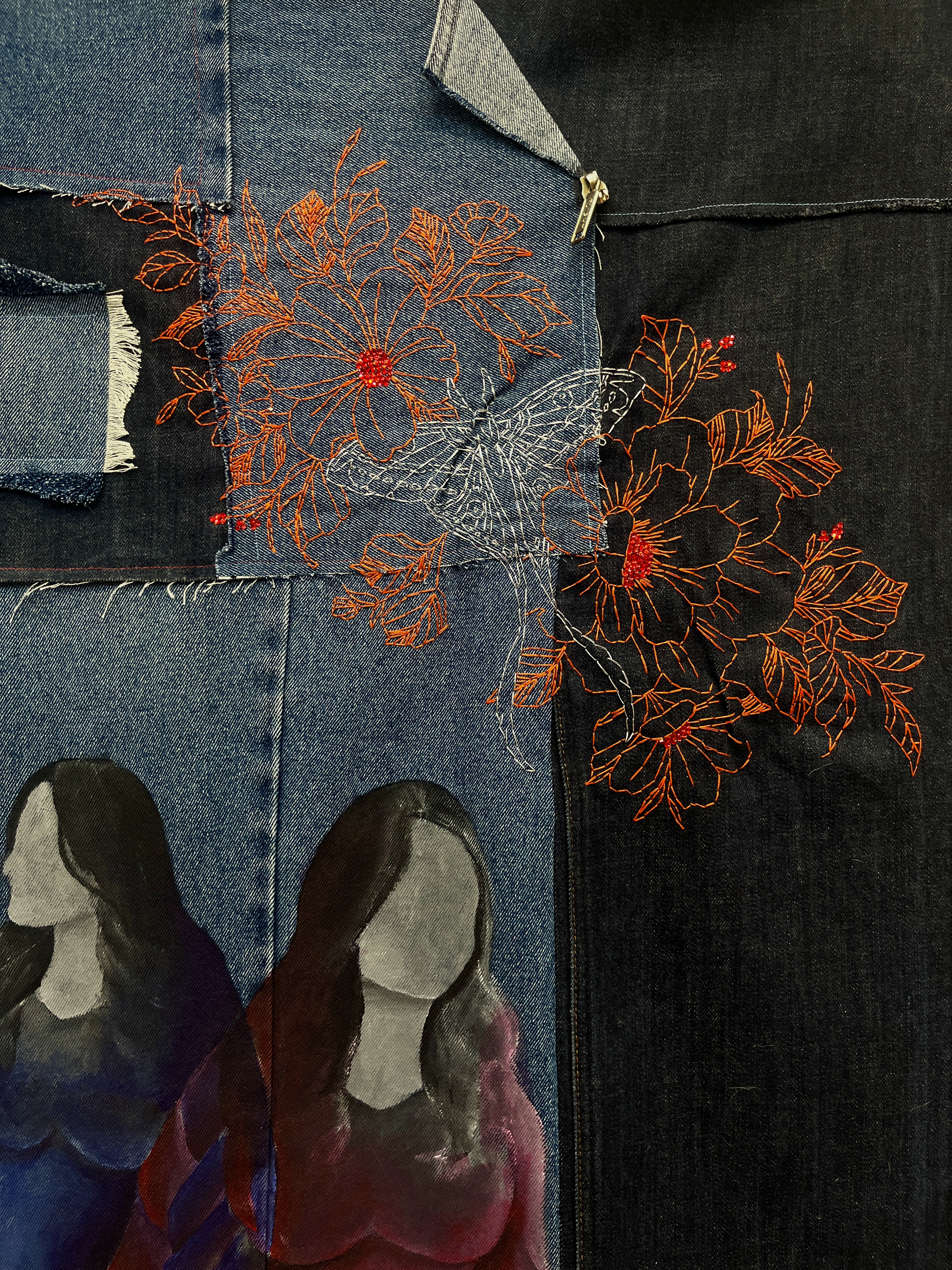
A: Baking paper is not as good as tissue paper (I sketch my designs for my embroidery onto tissue paper and embroider over it, using it as a guide and then tear the paper away once I’m done). Baking paper is not as easy to remove and is a lot stiffer to work with. I haven’t really learnt anything new, but reinforced what I learnt in my last year of high school, around me as an artist and my art style in terms of my subject matter, techniques and definitely colour schemes. I’ve noticed that I much prefer using blue and red over any other, and I think the colours themselves somewhat inspire the pieces I make with them. I learnt that I honestly don’t really care for conceptual as much as aesthetics (although I do understand how the conceptual side helps create cohesive pieces that don’t look really random, not a huge fan of Salvador Dali’s work).
How do you see art influencing your future career?
A: Making with your hands means you have strong dexterity and hand/eye coordination, which is a positive impact on nursing, given you need to be dexterous when inserting IVs, as well as probably being able to share my knowledge with patients who might benefit from learning the same skills, whether to help build up dexterity or muscle movement or even just to help provide an outlet. Being an artist gives you a keen eye for detail, which means you’re less likely to miss important details in someone’s health records while nursing. In terms of decompression, I do art for fun, and it would only really be a hobby to channel some energy into, so I don’t burn out. I feel like I don’t have to think as much and can just focus on brush strokes or my embroidery, or even just the composition; it gives my brain something to focus on that doesn’t take up too much energy.
How would you describe your creative process from concept to completion?
A: My creative process usually stems from an idea or an image I picture in my head that builds up as I go. I start constructing the original picture in my head, and along the way ill add to it with ideas and concepts that pop into my head. Sometimes I do a little experimenting to see what works, but more often than not I’ll get right into it and learn as I go. As my work develops, the initial image shifts in my head with the addition of concepts and ideas; sometimes, the image in my head completely changes throughout the process. However, if that doesn’t happen and the image stays the same, but my work doesn’t match it (which is often because it’s rare that the image and the final product look the same), I can get a bit fed up and leave it, resuming in a few days with fresh eyes. I don’t really know when it’s “done”, I simply just continue until I’m happy with the outcome and can’t think of anything to add or don’t want to change it.
Where do you find inspiration, and how do you handle creative blocks?
A: I usually take inspiration from other work I see on social media or from what I’m doing. I’ve always liked Bill Hammond’s work, especially “The Fall of Icarus”. The colours and techniques he uses, especially the materialism he uses, have always piqued my interest. I’ve also recently been inspired by Sophie Tea. I really like her work, and the colours she uses are always really pretty and cohesive. With art, I’m definitely more of an aesthetic viewer in the sense that I like a painting that looks pretty, even more when it has an interesting story, but the aesthetics are always at the forefront when I myself am creating. Occasionally, stories or concepts I like form images in my head that do inspire me, such as the 1986 film Labyrinth with David Bowie, for example. I recently read a book that takes inspiration from the story that I absolutely love, and whilst reading, I imagined some various pieces of art I could create with them as my inspiration. In terms of my pieces for the exhibition, Lydia Broderick and Jesus Leguizmo were a big part of my inspiration around some of the techniques they used in various pieces.
I often have creative blocks and honestly, just scrolling through Pinterest can give me a good starting point for a new project.
What have you learnt about yourself through working on this exhibition?
A: Baking paper is not as good as tissue paper (I sketch my designs for my embroidery onto tissue paper and embroider over it, using it as a guide and then tear the paper away once I’m done). Baking paper is not as easy to remove and is a lot stiffer to work with. I haven’t really learnt anything new, but reinforced what I learnt in my last year of high school, around me as an artist and my art style in terms of my subject matter, techniques and definitely colour schemes. I’ve noticed that I much prefer using blue and red over any other, and I think the colours themselves somewhat inspire the pieces I make with them. I learnt that I honestly don’t really care for conceptual as much as aesthetics (although I do understand how the conceptual side helps create cohesive pieces that don’t look really random, not a huge fan of Salvador Dali’s work).
How do you see art influencing your future career?
A: Making with your hands means you have strong dexterity and hand/eye coordination, which is a positive impact on nursing, given you need to be dexterous when inserting IVs, as well as probably being able to share my knowledge with patients who might benefit from learning the same skills, whether to help build up dexterity or muscle movement or even just to help provide an outlet. Being an artist gives you a keen eye for detail, which means you’re less likely to miss important details in someone’s health records while nursing. In terms of decompression, I do art for fun, and it would only really be a hobby to channel some energy into, so I don’t burn out. I feel like I don’t have to think as much and can just focus on brush strokes or my embroidery, or even just the composition; it gives my brain something to focus on that doesn’t take up too much energy.
Charlotte’s exhibition, Tailor-made is on display from 11 April to 4 July 2026 in the concourse.
Click here to read more about her exhibition.